Story · Ages 6–9
The Elephant and the Six Blind Men
Six people touch the same animal. They all describe something different.
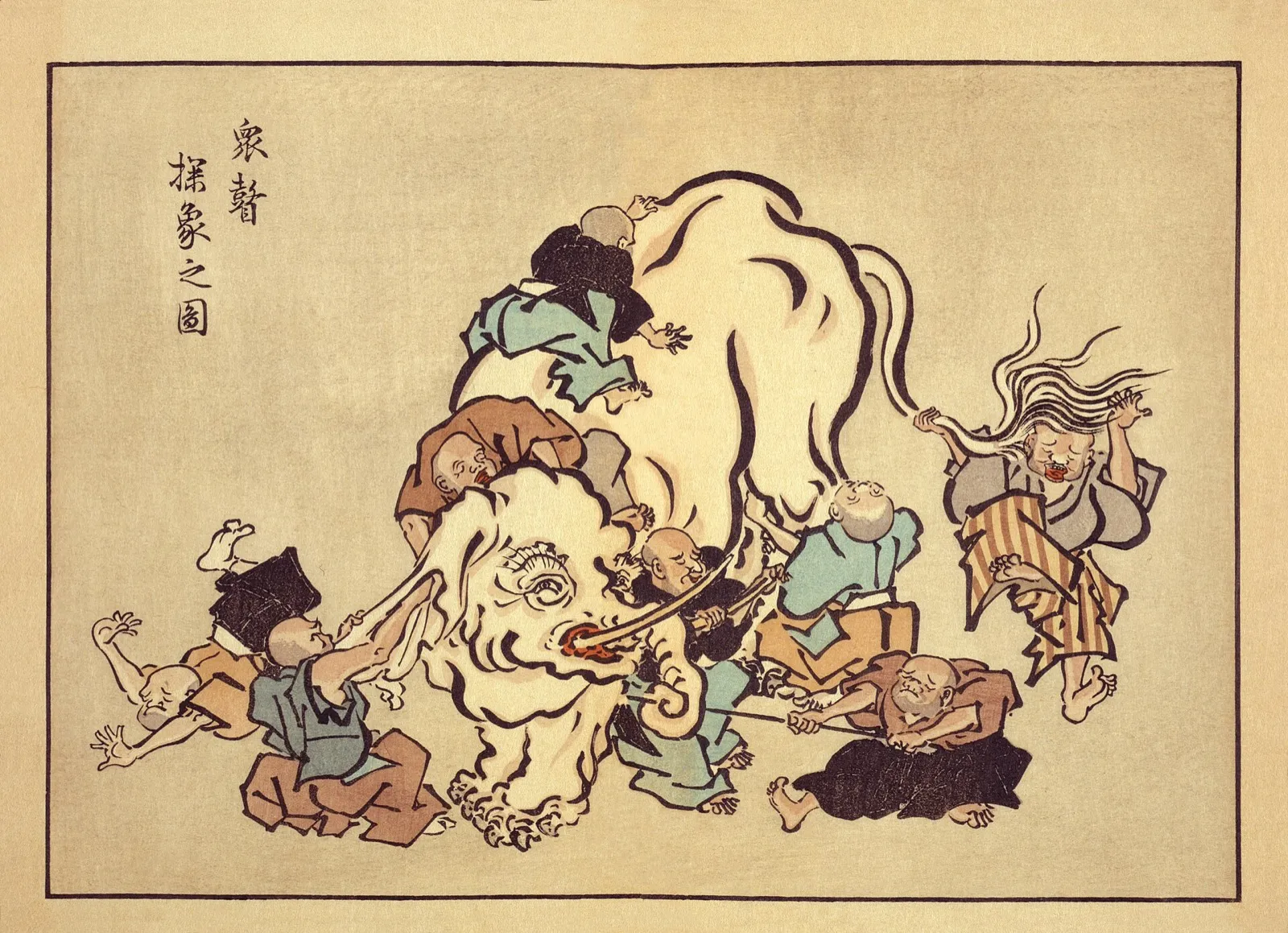
Some people in a village had never seen an elephant. One was brought to the edge of the town, and six men who could not see were taken to it, and each of them put out a hand.
The first one found the trunk, which was long and bendy and moved. “An elephant,” he said, “is like a snake.”
The second one found an ear, which was wide and flat and thin. “No,” she said. “An elephant is like a fan.”
The third one found a leg, which was thick and round and did not move at all. “You are both wrong. An elephant is like a pillar.”
The fourth found the side of it, big and warm and solid. “It is like a wall.”
The fifth found the tail, with a tuft on the end. “It is like a rope.”
The sixth found a tusk, smooth and pointed and hard. “It is like a spear.”
And then they argued, because each one of them was certain, and each one of them was describing something that was really there.
The point of the story, in the old telling, is usually about people who are sure they are right and quarrel with everyone else. But there is a second layer, and it is worth noticing. Every one of the six was describing something true. That is exactly why it is hard: not one of them was making it up. They were all reporting honestly, from the small part of the animal they could reach — and none of them could tell, from where they were standing, that they were only touching a piece.
What it is really asking
Can everybody be partly right and still be wrong?
How to tell it
Use a scarf or a coat and let the child feel it blindfolded. Then argue about what it is.
Where this story comes from
An old Indian parable, written down in a Buddhist collection called the Udana
Told for well over two thousand years, in India and far beyond it. There are Jain versions, Sufi versions and Persian versions, all making the same point in slightly different ways.
This is a retelling, not a translation. The words are ours; the story is theirs.