Story · Ages 6–9
The Bundle of Sticks
One stick snaps. A bundle doesn't. So what exactly is the bundle?
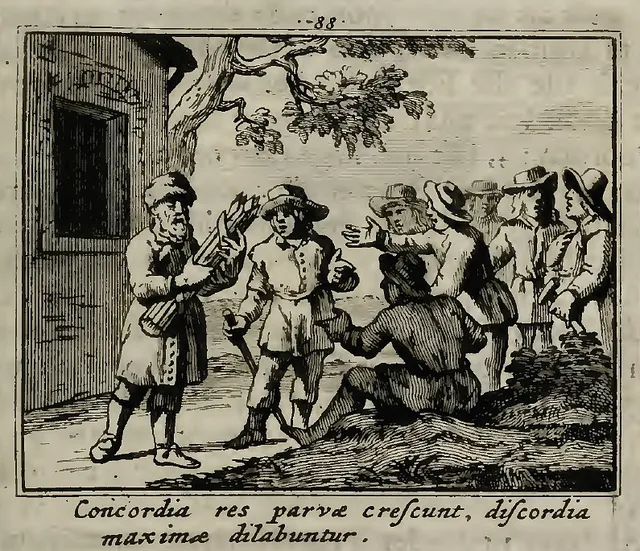
A merchant had four sons who argued the way weather happens: constantly, and over everything. They argued about whose turn it was, whose fault it was, and whose idea had been best. The merchant worried that one day they would argue themselves apart.
One day he called them to the table and set down a bundle of sticks, tied with string.
Break it, he said to the eldest.
The son pulled. The bundle bent and did not break. He tried with both hands, then against his knee. Nothing. One by one the other sons tried, and one by one they failed. Four strong boys, and no match for a bundle of sticks.
The merchant untied the string and handed each of them a single stick. Now. Each stick snapped with a small, satisfying crack.
You are the sticks, he said. Together, none of you can be broken. Apart, I could snap every one of you with my thumb.
That is the story as it is always told, and the moral comes ready-made: stick together. But it is worth poking at.
A bundle holds because string squeezes every stick toward the others. What is the string in a family, or a class, or a country? And what happens to the stick that does all the holding while another one leans on it? A bundle is strong, all right — nobody says a bundle is fair.
So the story leaves two questions instead of one. What holds your people together? And when the bundle pulls tight, does every stick get a say?
What it is really asking
What can your family, or your class, do together that nobody in it could do alone?
How to tell it
Bring actual sticks, or chopsticks, and let everyone try to snap the bundle first. The story lands better if the bundle wins in your kitchen.
Where this story comes from
Aesop, “The Bundle of Sticks”
A Greek fable about a merchant and his squabbling sons. Versions of the same story appear in India and in China, which suggests every place needed it.
This is a retelling, not a translation. The words are ours; the story is theirs.