Story · Ages 8–12
The Cave
What if you had never seen anything but shadows?
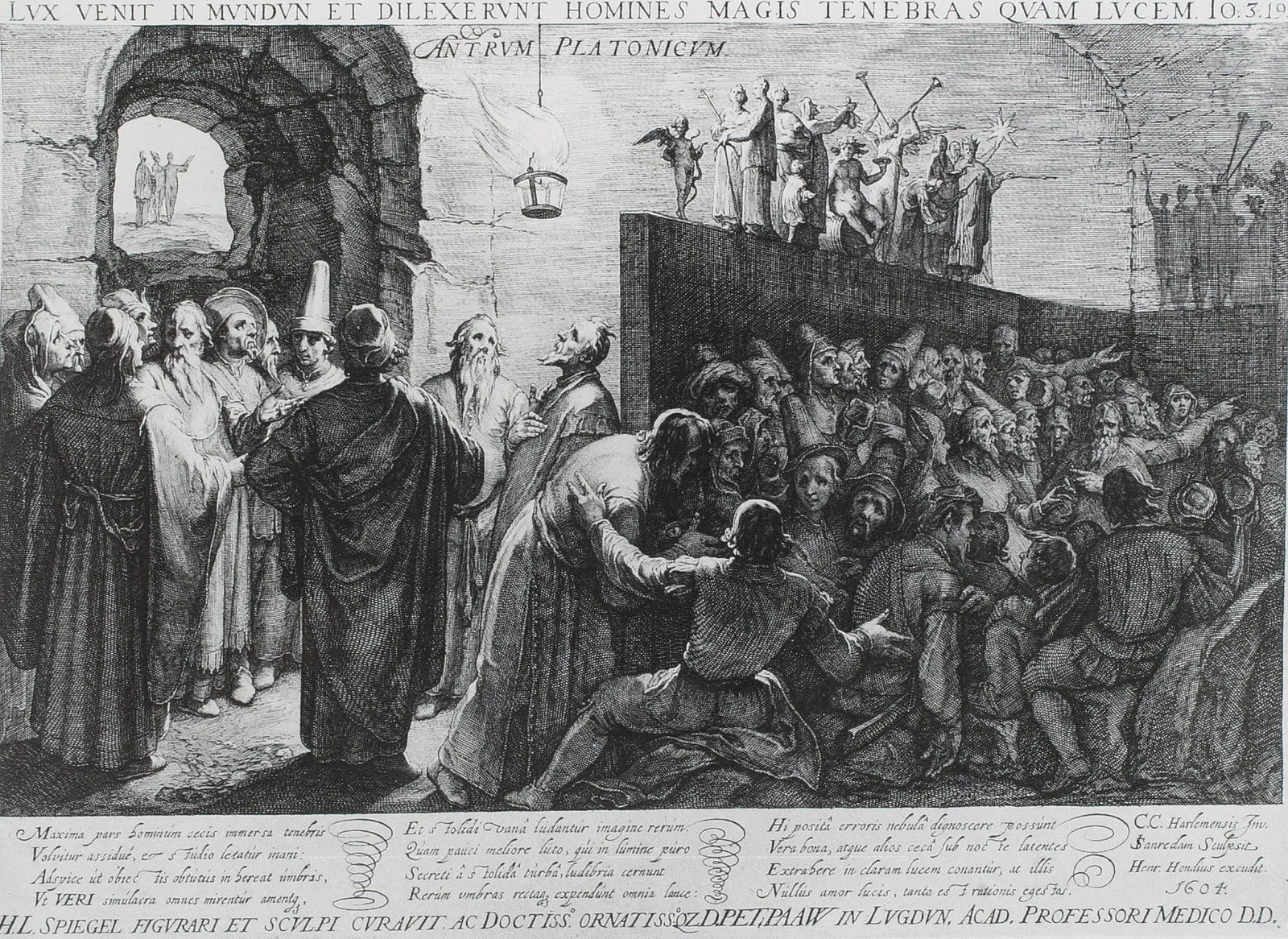
Imagine a cave underground, with a long tunnel leading up to the daylight.
Deep inside, some people have been prisoners since they were babies. Their legs and necks are held so they can only look at one wall. Behind them is a fire, and between the fire and the prisoners is a walkway where other people carry things past — a bowl, a jug, a little wooden horse. The prisoners cannot turn round. All they ever see, on the wall in front of them, are the shadows those things cast.
They give the shadows names. They argue about which shadows are which, and they are good at it — better than you would be. They know the order the shapes come in, and who is cleverest at guessing what comes next. They think the shadows are the whole world, because why wouldn’t they.
One day a prisoner is set free. At first he is baffled. The people and the things he used to see as shadows are right there, in front of him, and they are solid. He is told he is seeing what is real, and he does not believe it. He wants to go back to the wall, where things made sense.
Then he is dragged up the tunnel, and the sunlight hurts. He cannot see anything for a while. Slowly, though, he gets used to it. He sees the sky, then the sun, and he works out that the sun is what makes everything else visible. And he thinks of the prisoners still down there, and how they would call him mad if he told them what he had found.
He goes back. And their eyes are used to the dark, and his are ruined by the light, and he cannot do the shadow-guessing any more. He stumbles.
So what do they say about him? Plato is blunt about it: they would say the trip outside ruined him, and if anyone tried to set them free and take them up that tunnel, they would kill him.
What it is really asking
Are you sure that everything you can see is everything there is?
How to tell it
Tell it slowly and stop at the hard part: when the freed prisoner goes back. Ask what the other prisoners would think of him before you say what Plato says.
Where this story comes from
Plato, The Republic, Book VII
Written about 2,400 years ago. Plato says it is a picture of what learning is like — and of what people do to the person who learns something they did not want to hear.
This is a retelling, not a translation. The words are ours; the story is theirs.