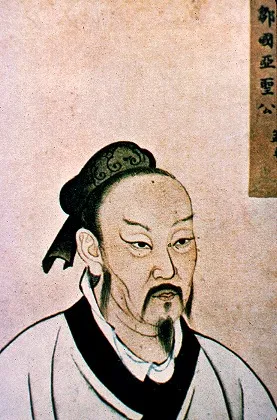
How to Live · c. 372–289 BCE
Mencius
He argued that people are born good, and that the work of a life is not to become good but to stop losing it.
Zou, China · lived 372 BCE – 289 BCE
Their big question
Are people born good?
Mencius was born a century after Confucius and spent his life arguing with people about human nature. Another thinker, Xunzi, said people are born selfish and need to be trained into decency. Mencius said the opposite: we come with four beginnings, and the job is not to install them but to keep them alive.
His proof is a small thought experiment. Imagine you suddenly see a child about to fall into a well. You lurch. You do it before you have worked out whether anyone is watching, before you calculate anything. Mencius says that lurch is the evidence — the beginning of compassion, built in, not taught.
Then comes the harder half of his argument, which people who quote the first half tend to forget. A sprout is not a tree. If you do not water it, or if you pull it up to make it grow faster, it dies. He thought most people are not bad; they are untended. Goodness is lost slowly, by neglect, and found again the same way.
He also had a message for rulers, and it was not a polite one. If a king makes his people’s lives impossible and then wonders why they do not love him, Mencius thought he had misunderstood his own job. A ruler who is not nourishing the people growing under him is not a king being failed by his subjects.
“The feeling of commiseration is the beginning of humaneness.”
His test is the child at the well: anyone would lurch towards a drowning child, before any thought of reward.
Three things worth knowing
- His test case for human goodness is the child at the edge of a well: everyone, he says, would rush to stop it — not for thanks, not for reward, just because.
- He said that feeling is only a sprout, and that a sprout needs watering for years. Goodness is potential, not achievement.
- He spent decades visiting rulers to argue that a king who governs by force has already lost, and mostly they did not listen.
Try it — think like Mencius
Watch for one unplanned reaction in yourself today — the flinch when someone else is hurt before you have had time to decide anything. That reaction is what Mencius is talking about.
Mencius2 — Original uploader was Hardouin at en.wikipedia. Source on Wikimedia Commons.