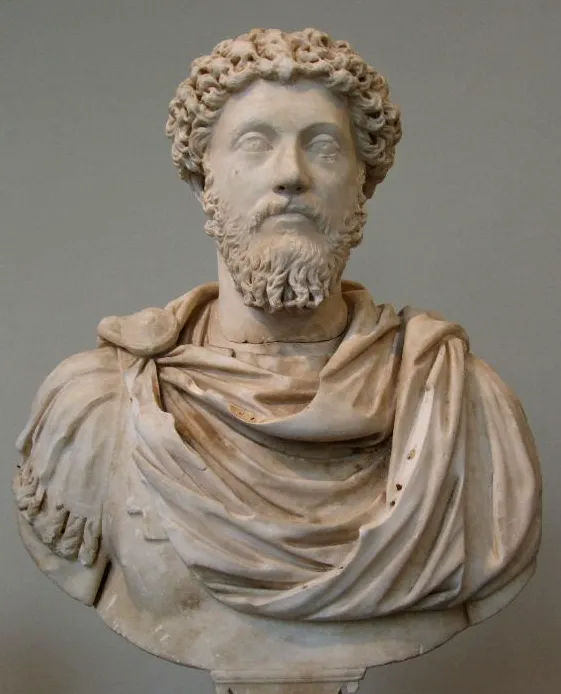
How to Live · 121–180 CE
Marcus Aurelius
The most powerful person in the world kept a notebook telling himself to stop worrying about things he could not control.
Rome · lived 121 – 180
Their big question
What is actually up to you?
Marcus Aurelius was the most powerful man alive, and his private notebook is one long argument with himself about how little that was worth.
The notebook — we call it Meditations, though he never gave it a title — is not philosophy written to impress anyone. He wrote it in Greek, in fragments, between campaigns, as a set of reminders: that fame fades, that most of what he was afraid of was inside his own head, that losing his temper with a difficult person is a decision he makes, not something that happens to him. The Stoics he followed taught that there are two kinds of thing in the world: what is up to you, and what is not. Your opinions, your choices, your character: those are yours. Your health, your reputation, the weather, other people, whether you live or die: not yours.
Read the whole of it and a strange picture comes through. He is not serene. He is clearly tired, often annoyed, frequently reminding himself of things he already knew, because he kept forgetting them. The book is a man arguing himself into patience over and over again, in the middle of a war, with the plague going around.
He wrote near the end: use what is in your power like a free person, instead of wanting what is not in your power like a slave. It is advice he was giving himself, and by the evidence of the notebook, it kept needing to be given.
“Is it not better to use what is in thy power like a free man than to desire in a slavish and abject way what is not in thy power?”
He wrote it in Greek, to himself, in a war camp near a river. He never meant anyone to read it, which is exactly why it is honest.
Three things worth knowing
- He was Roman emperor for nineteen years, and spent much of that time away from Rome, fighting on the northern frontier.
- Meditations is not a book he wrote for readers. It is a private notebook, full of reminders to himself, in no order at all.
- He had the most power a person could have, and his notebook is mostly about how little of what happens is actually up to him.
Try it — think like Marcus
Draw a line down a page. On one side write what is up to you, on the other what is not. Put five things from today into the two columns, honestly. Most people are surprised by how short the first column is.
Marcus Aurelius Metropolitan Museum — User:Steerpike. Source on Wikimedia Commons.