Living Together · 1648–1695
Sor Juana Inés de la Cruz
A nun in Mexico who taught herself everything, argued with a bishop, and asked why girls were not allowed to learn.
New Spain (Mexico) · lived 1648 – 1695
Their big question
Why were girls not allowed to learn?
Juana Inés de la Cruz was born on a farm outside Mexico City and grew up with a problem: she wanted to know everything, and everyone around her agreed that this was not what girls were for.
She solved it by teaching herself, reading her grandfather’s books until she ran out of them. She was famous by sixteen for her mind, and the only place she could keep studying was a convent — so she became a nun, because at least a convent had a library. She wrote poetry, plays, science, and arguments. She collected musical and scientific instruments. She wrote a great deal that was about nothing more religious than wanting to understand how things worked.
Then she criticised a famous sermon, and a bishop — writing under a woman’s name — told her publicly to leave off secular learning and mind her prayers. Her answer, the Respuesta a Sor Filotea, did not apologise. She listed the educated women she could think of, from the Bible onwards, to show the bishop the size of the tradition he wanted her to ignore. She pointed out that if women were taught nothing, of course they would seem to have learned nothing. And, most effectively, she observed that thinking is not something you need a study for: you can perfectly well philosophize while cooking supper.
She was made to give up her books in the end. She died a few years later, nursing other nuns through an epidemic.
“One can perfectly well philosophize while cooking supper.”
A bishop had told her to stop studying. This was her reply — she was quoting an older poet, and she meant every word of it.
Three things worth knowing
- She wanted to study at university, so as a girl she asked to be dressed as a boy to get in. She was refused.
- She learned to read in a library her grandfather owned and taught herself Latin, philosophy and science, and wrote in both Spanish and Nahuatl, the language of the people around her.
- Her reply to a bishop in 1691 — the Respuesta — is one of the first great arguments in the Americas for a woman's right to be educated.
Try it — think like Sor
Next time you wash up, sweep, or walk somewhere boring, keep half your mind on one question that interests you. Afterwards write down whatever turned up. Thinking does not need a desk.
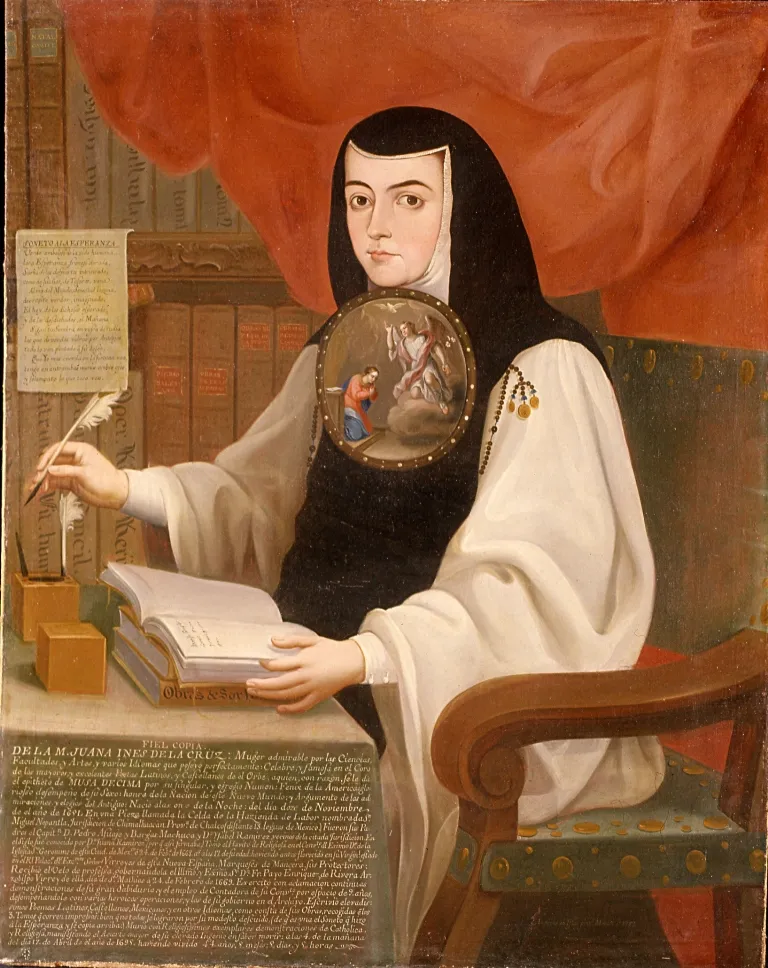
Sor Juana Inés de la Cruz (1772) — Andrés de Islas. Source on Wikimedia Commons.