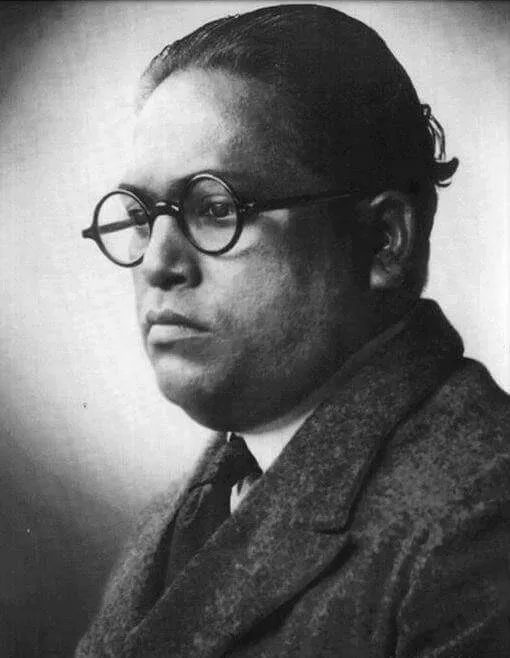
Living Together · 1891–1956
B. R. Ambedkar
He argued that a society can be built so that people are sorted at birth — and then spent his life dismantling that arrangement in law.
India · lived 1891 – 1956
Their big question
Is an unequal society stable, or only quiet?
Ambedkar’s question is one that a lot of philosophy skips: what if the unfairness is not a bad decision that can be corrected, but the structure of the society itself?
Caste, as he analysed it, is not a division of labour — a society where different people do different jobs is ordinary enough. It is a division of labourers: which job you may do, who you may marry, who may touch your food, is decided at birth and cannot be changed by effort or talent. And it is defended twice, once by custom and once by a story about why the arrangement is natural. That double defence is what makes it so hard to dislodge, because the person at the bottom is asked to accept that the bottom is where they belong.
He refused the polite version of the argument. Others argued for gradual reform, or for improving conditions within the system. He argued that the system itself was the problem, and then did something unusual for a philosopher — he went into the machinery. He wrote in law, drafted a constitution, founded organisations, published arguments, and finally used mass public conversion to make the departure visible.
Which is why he belongs in a library for children. He is the clearest case of a thinker who did not treat understanding and action as separate jobs, and who took an argument all the way into institutions rather than stopping at a book.
“Caste is not a division of labour; it is a division of labourers.”
His central claim against the defence that caste is simply people doing different jobs — the difference being that one is chosen and the other is inherited.
Three things worth knowing
- He was born into a caste treated as untouchable, was the first member of it to attend an Indian university, and went on to earn doctorates in New York and London.
- He chaired the committee that drafted the constitution of independent India, and the equality and rights clauses in it carry his fingerprints.
- In 1956 he and hundreds of thousands of followers publicly left Hinduism for Buddhism, in a decision he described as being about dignity rather than belief.
Try it — think like B.
Find one rule where you live — in school, sport or law — that is technically the same for everyone and in practice is not. Write how it works on the person it favours and on the person it does not.
Dr. Babasaheb Ambedkar as young — Unknown authorUnknown author. Source on Wikimedia Commons.