What Is Real · c. 150–250 CE
Nagarjuna
He argued that nothing exists on its own — everything is what it is because of everything else.
South India · lived 150 – 250
Their big question
If everything depends on something else, what holds it all up?
Nagarjuna’s question sounds strange at first: what is a thing, apart from everything it depends on?
Look at a wooden table. Take away the tree, the carpenter, the saw, the forest, the rain that grew the tree — take away every one of those, and what is left? Nothing you could point at. Nagarjuna said this is not just true of tables. It is true of everything, including you. A thing has no independent core, no little solid self inside it. He called that emptiness: not empty as in nothing there, but empty as in nothing there on its own.
This worried people in his own time and it worries people now. If nothing exists on its own, isn’t everything just an illusion? Nagarjuna said no, and this is the careful part. Things are real enough to walk into. They are just not what we assume they are: permanent, separate, self-powered. He called his position the middle way, because it sits between saying things really exist and saying they do not exist at all.
He also said something that makes the mind wobble if you hold it: the idea of emptiness is itself empty. It is not a secret fact about the universe you can cling to. It is a tool for noticing what you had been assuming — and then you put the tool down.
“We call that which is dependent origination emptiness. That, being a dependent designation, is itself the middle way.”
Hard words for a simple thought: a thing has no fixed self of its own, because it is made of its relationships to everything else.
Three things worth knowing
- We know very little for certain about his life — no reliable dates, no reliable birthplace. What survived is the argument, not the biography.
- His Root Verses on the Middle Way are still studied today in Sanskrit, Chinese, Tibetan, Korean and Japanese.
- He did not say that nothing exists. He said that nothing exists *by itself* — and that this is not a sad fact but a freeing one.
Try it — think like Nagarjuna
Pick up something you own. Ask what it is made of, who made those parts, who grew or dug them. Follow it back as far as you can. Try to find the one thing in the chain that does not depend on anything else.
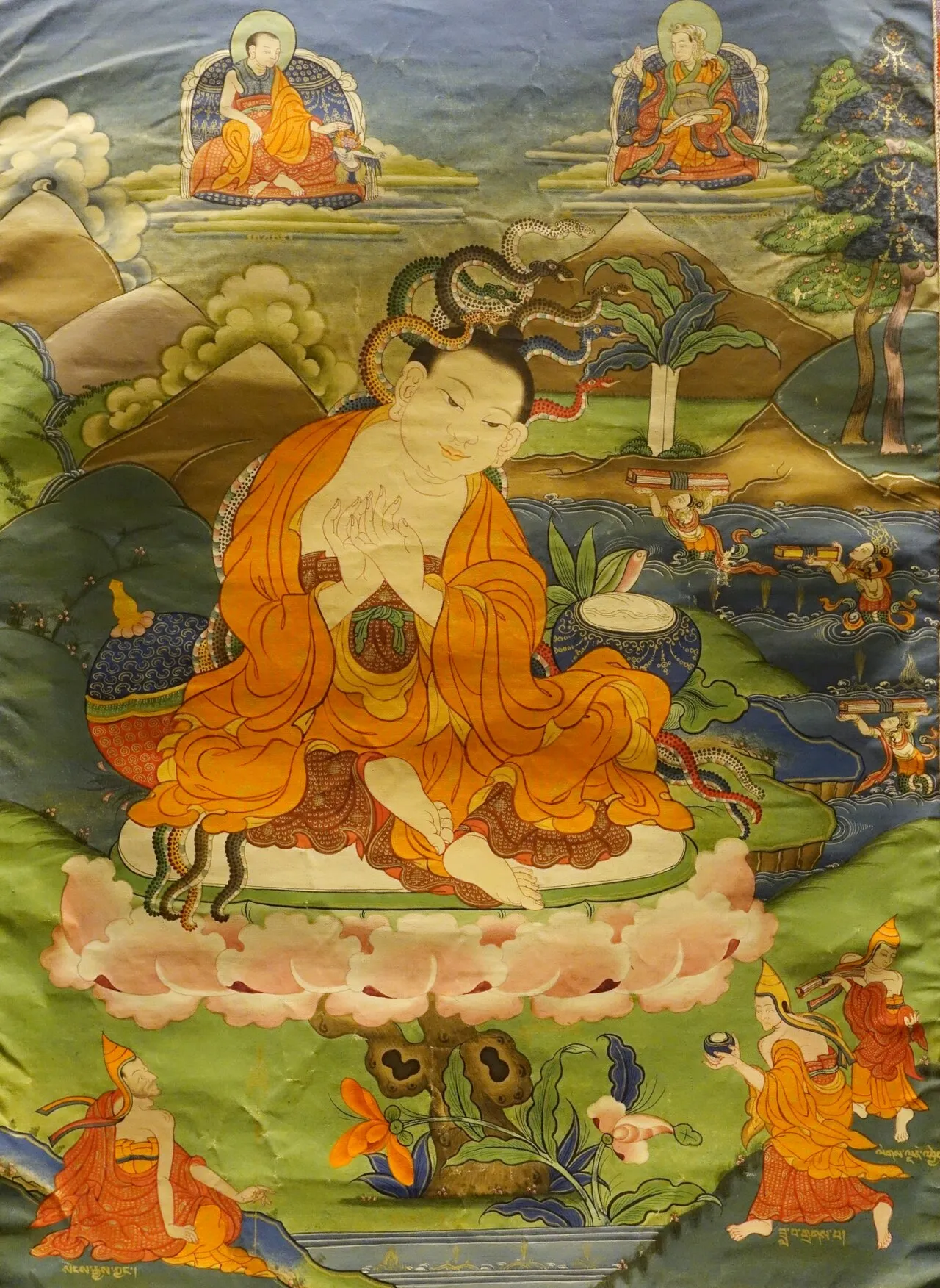
Nagarjuna, Tibet, 1644-1911 AD - Sichuan Provincial Museum - Chengdu, China - DSC04486 — Daderot. Source on Wikimedia Commons.